StageShift Technology
Origin, signal path and tools
Convolution of the live signal with measured room impulse responses on Android, iPhone and iPad, with a shared C++ core and open source code.
Origin
StageShift comes from the VRET project. In the lab the Augmented Practice Room by IEM Graz provides room sound, precisely but with a computer, cables, a head tracker and supervision. Frank and Bertsch (2024) describe the principle: keep the real direct sound through open headphones and add only the room with minimal delay. In the youth orchestra field study the lab setup was not portable enough, so the VR scenes ran without live room sound (Bertsch et al., 2026). StageShift makes this part portable.
Student theses showed the need early on: Stöger (2020) missed a shared room sound with the accompanist, Bramböck (2022) proposed a simple app, Auer (2023) and Kollreider (2026) found that room sound matching the picture shapes presence and satisfaction.
Signal path
- Microphone / interface
- Selected room response
- Headphone correction (optional)
- Limiter
- Headphones
Processing stays local from input to output. Files and filters are prepared outside the time-critical audio path. Processing only starts after Start and microphone permission and stops in a controlled way if the audio output disappears, an interruption occurs or the app goes to the background. A final limiter reduces digital peaks; the level at the ear still depends on headphones and device.
Specifications
| Platforms | Android, iPhone, iPad; native interfaces, shared design system, shared C++ audio core |
|---|---|
| Method | real-time convolution with measured room impulse responses (WAV); Legacy and Optimized variants |
| Rooms | Beta: 20 entries plus “Direct” (11 named measured venues, 9 general rooms). Development catalogue: 16 named venues, 25 entries, incl. Graz Cathedral, Ligeti Hall, IEM experimental studio, Goethehäuschen, Calypso (TU Berlin) |
| Headphones | 6,224 model profiles offline, correction can be toggled, target and correction shown as graph; profile authors and licences in the app, catalogue exportable with licence information |
| Input | built-in microphone or class-compliant USB audio interface; input and channel selection |
| Output | wired or USB; Bluetooth not recommended due to latency |
| Data | no recording, no upload, no account, no analytics or tracking SDKs; settings and IR edits stored locally |
| Licence | project code Apache-2.0; room data and headphone profiles under their own licences, sources and licence texts offline in the app |
| Languages | German, English; larger text and platform accessibility features |
| Quality assurance | automated signal, state, UI, build and package checks, checksum verification |
For nerds
The advanced tools live in a separate area. It is free, experimental and without support; basic knowledge of acoustics helps. Access on request by email to bertsch@mdw.ac.at.
IR-Lab
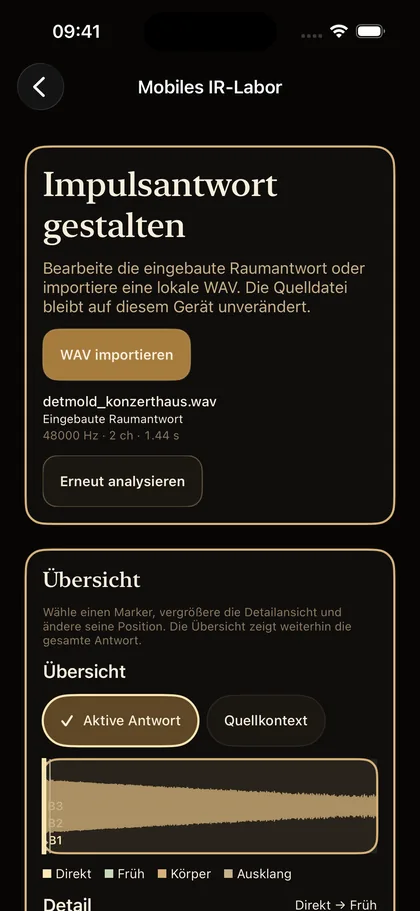
An impulse response describes how a room reacts to a short sound. In the IR Lab you open the response of an existing room or import your own WAV file. Automatic analysis and suggestions help with alignment and segmentation.
- Attenuate or mute four regions separately: direct sound, early reflections, reverberant body, late decay
- Boundaries, start point and overall level adjustable; time intervals also shown as path length differences
- System latency compensation using the time headroom of the room response
- Undo, A/B comparison, preview; the original is kept
Audio tools
- Buffers, device profiles and compensation between input and output clocks
- Android: buffer calibration, saved profiles, stability hints
- Local diagnostics of audio paths, buffering, processing times and errors
- Guided latency test via a stereo USB connection with electrical loopback; values depend on device, OS, interface and settings
Open research questions
- What delay still feels natural for voice, strings, winds, piano and guitar?
- How do open, closed and in-ear headphones differ in self-perception and playing feel?
- How exact must a room response be to match the venue you see: reverberation time, early reflections, frequency response?
- Is practising at the actual venue, seen in VR and heard with StageShift, more effective than in generic halls?
References
- Bertsch, M., Roos, M., Leitz, T., Smale, M., & Reuter, C. (2026). Sound, stress, and health in youth orchestras: Feasibility of a multimodal psychophysiological health promotion program. Frontiers in Psychology, 17, 1742780. https://doi.org/10.3389/fpsyg.2026.1742780
- Frank, M., & Bertsch, M. (2024). Virtuelle Akustik für musikalisches Training. Akustik Journal, 2024(1), 16–18.
- Frank, M., Rudrich, D., & Brandner, M. (2020). Augmented practice-room – Augmented acoustics in music education. In Fortschritte der Akustik – DAGA 2020. DEGA.
- Klanjscek, N., David, L., & Frank, M. (2021). Evaluation of an e-learning tool for augmented acoustics in music education. Music & Science, 4. https://doi.org/10.1177/20592043211037511
- Zotter, F., & Frank, M. (2019). Ambisonics: A practical 3D audio theory for recording, studio production, sound reinforcement, and virtual reality. Springer. https://doi.org/10.1007/978-3-030-17207-7
Student theses: Stöger (2020), Bramböck (2022), Auer (2023), Kollreider (2026); full details on the VRET science page.